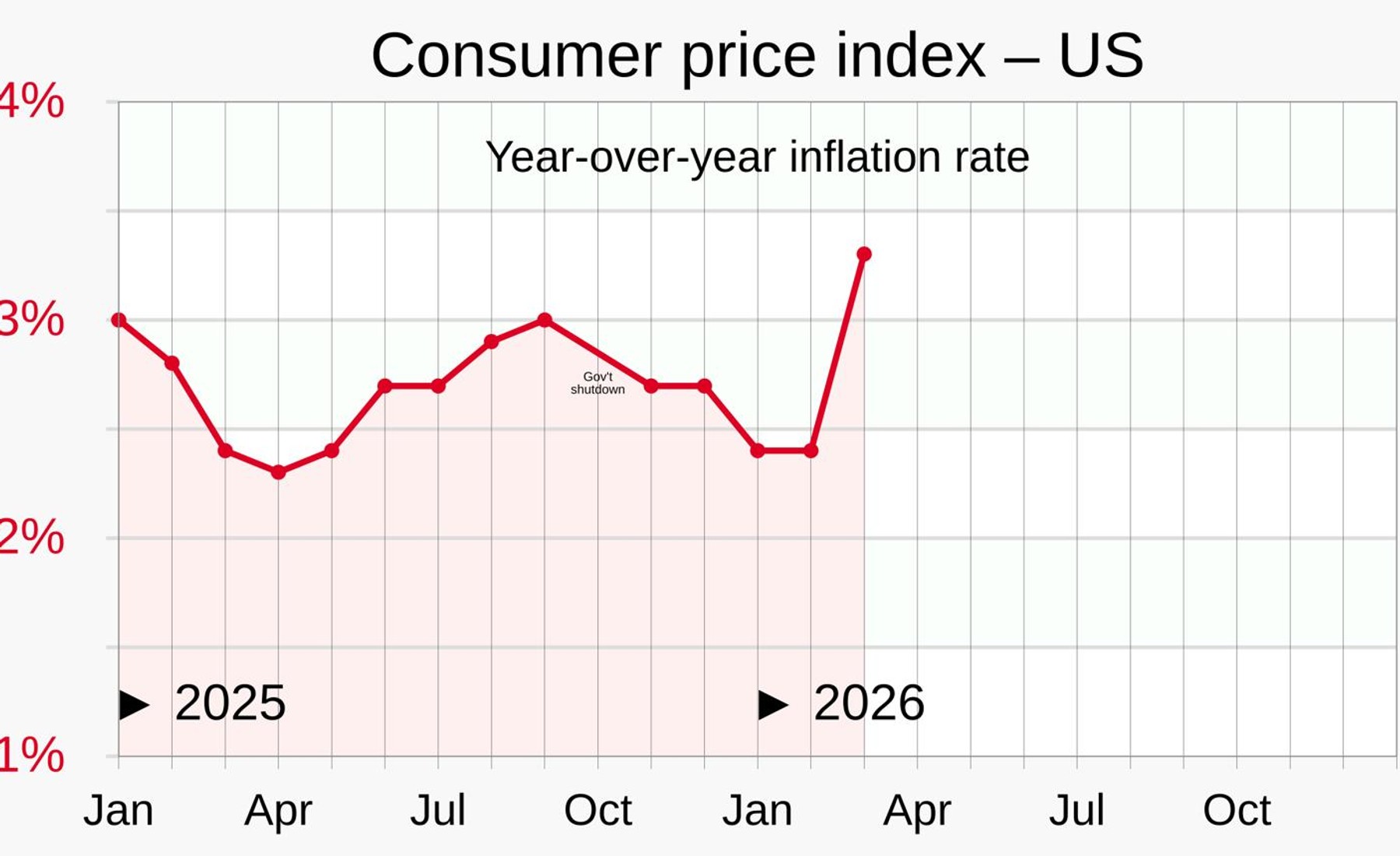
Consumer prices in the United States increased more than economists expected in October, keeping inflation concerns firmly in focus as the Federal Reserve considers whether to raise interest rates again before the end of the year.
Figures released by the US Bureau of Labor Statistics on Tuesday showed that the Consumer Price Index rose 0.4% in October, following a 0.6% increase in September.
Economists surveyed by Reuters had expected a smaller monthly increase of 0.3%.
Although the pace of overall price increases slowed compared with September, the latest reading suggests that inflationary pressure remains persistent across several areas of the American economy.
Prices excluding food and energy, a measure closely watched by policymakers for signs of underlying inflation, increased 0.3% for the third consecutive month.
Food prices rose 0.5%, including a 0.4% increase in grocery prices. The cost of eating away from home also increased 0.5%.
Energy prices rose 0.7%, considerably slower than September's 5.2% increase. Gasoline prices increased 1%, while electricity costs rose 0.9%.
Housing costs remained another source of pressure, with the shelter index rising 0.3% and accounting for more than 30% of the monthly increase in overall consumer prices.
The report also recorded increases in medical care, vehicle insurance, recreation and education, indicating that higher costs were not confined to energy and food.
One notable limitation in the report was the absence of the usual annual inflation rate.
The Bureau of Labor Statistics said it could not calculate most year-on-year comparisons because the federal government shutdown in October 2025 prevented the collection of the corresponding data.
The October figures therefore provide a monthly comparison rather than a complete annual picture of price changes.
The stronger-than-expected reading has reinforced expectations that the Federal Reserve could raise borrowing costs at its December policy meeting.
The central bank is seeking to bring inflation towards its 2% target while avoiding unnecessary damage to economic growth and employment.
Financial markets reacted negatively to the report, with US stocks falling and Treasury yields rising as investors reassessed the likely direction of interest rates.
Higher US interest rates can have consequences beyond the American economy. They influence international capital flows, currency markets and borrowing conditions in other countries, including emerging markets.
For households, the latest figures underline the continuing pressure from everyday expenses despite the slowdown in the monthly rate of inflation.
For policymakers and investors, the question is whether price pressures will ease sufficiently in the coming months to reduce the need for further monetary tightening.
The Federal Reserve's next decision will depend on subsequent economic data and its assessment of the balance between inflation and economic activity.