SpaceX has achieved a major milestone in reusable spaceflight after its Starship spacecraft returned from orbit and was caught by mechanical arms at the company's launch tower in Texas.
The spacecraft completed its return on Saturday, November 14, approximately 22 hours after launching from Starbase on Friday.
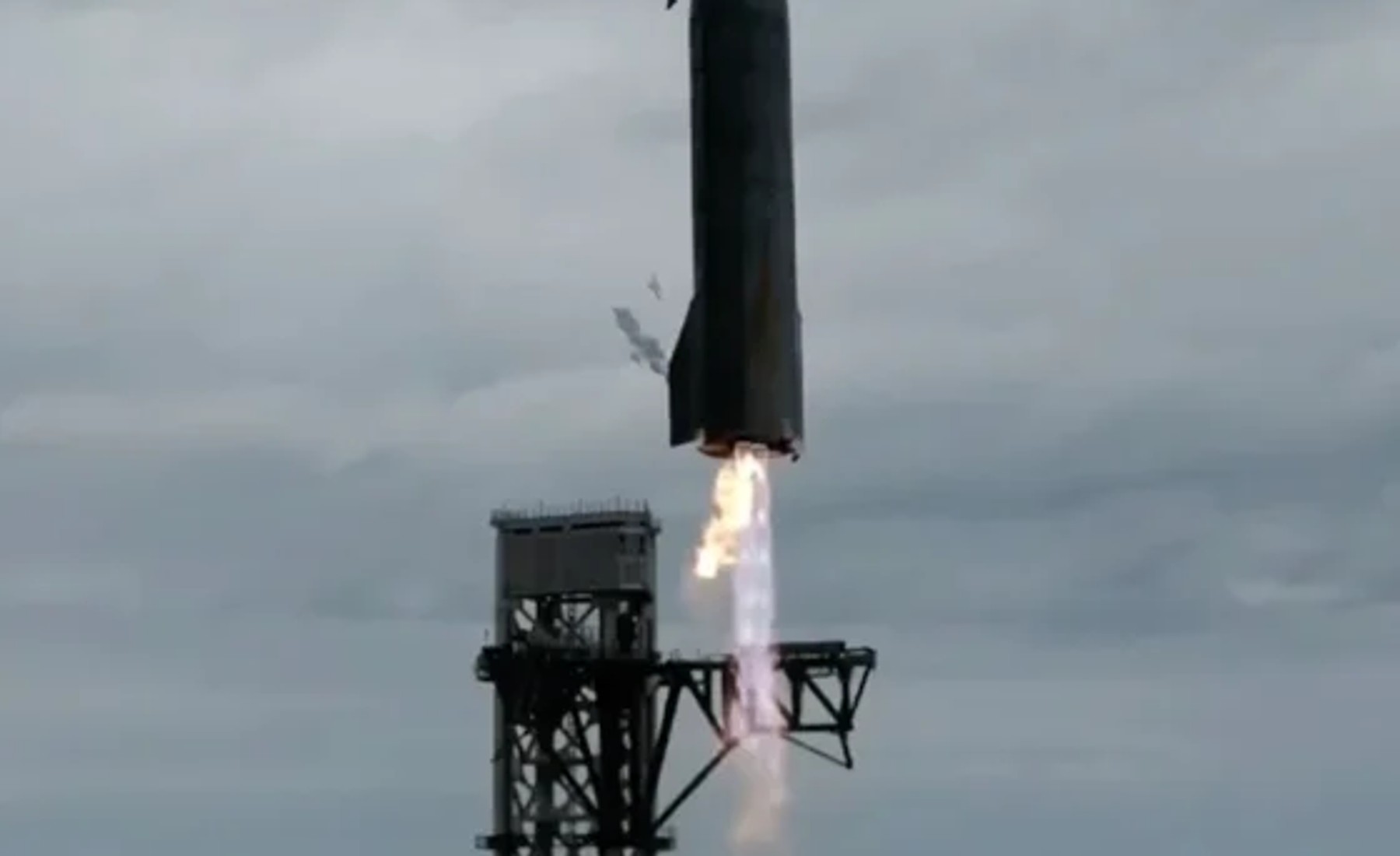
The upper-stage vehicle descended towards Launch Pad 2 and was secured by the tower's giant mechanical arms, commonly known as chopsticks.
It was the first time SpaceX had recovered a Starship upper stage in this manner following an orbital flight.
The achievement represents an important advance in the company's ambition to develop a fully reusable rocket capable of carrying large payloads, satellites and eventually people on missions beyond Earth orbit.
During the flight, Starship completed 14 orbits of Earth and deployed 26 Starlink satellites, according to mission reporting.
The spacecraft also underwent the demanding process of atmospheric re-entry, during which its thermal protection system was tested.
SpaceX officials said the spacecraft's systems, including its heat shield, appeared to perform well.
The mission was not entirely successful. The Super Heavy booster, which powered Starship during the initial stage of launch, was lost after encountering problems during its return.
SpaceX had hoped to recover both the booster and the upper-stage spacecraft, but the booster failed to complete its planned catch.
Engineers are investigating the cause of the booster failure.
The successful recovery of the upper stage nevertheless marks a significant development for Starship, which is central to SpaceX's long-term plans for more frequent and less expensive space launches.
NASA also has a major interest in the programme, having selected a version of Starship for its Artemis lunar landing plans.
NASA Administrator Jared Isaacman welcomed the achievement in a social media statement.
The recovery does not mean Starship is already capable of routine commercial reuse. SpaceX must still demonstrate that recovered vehicles can be inspected, refurbished and flown again reliably.
The company also faces further testing and regulatory requirements as it works towards regular Starship operations.
For now, the successful tower catch represents one of the programme's most important technical accomplishments, bringing SpaceX closer to its goal of recovering both major sections of its largest rocket system.