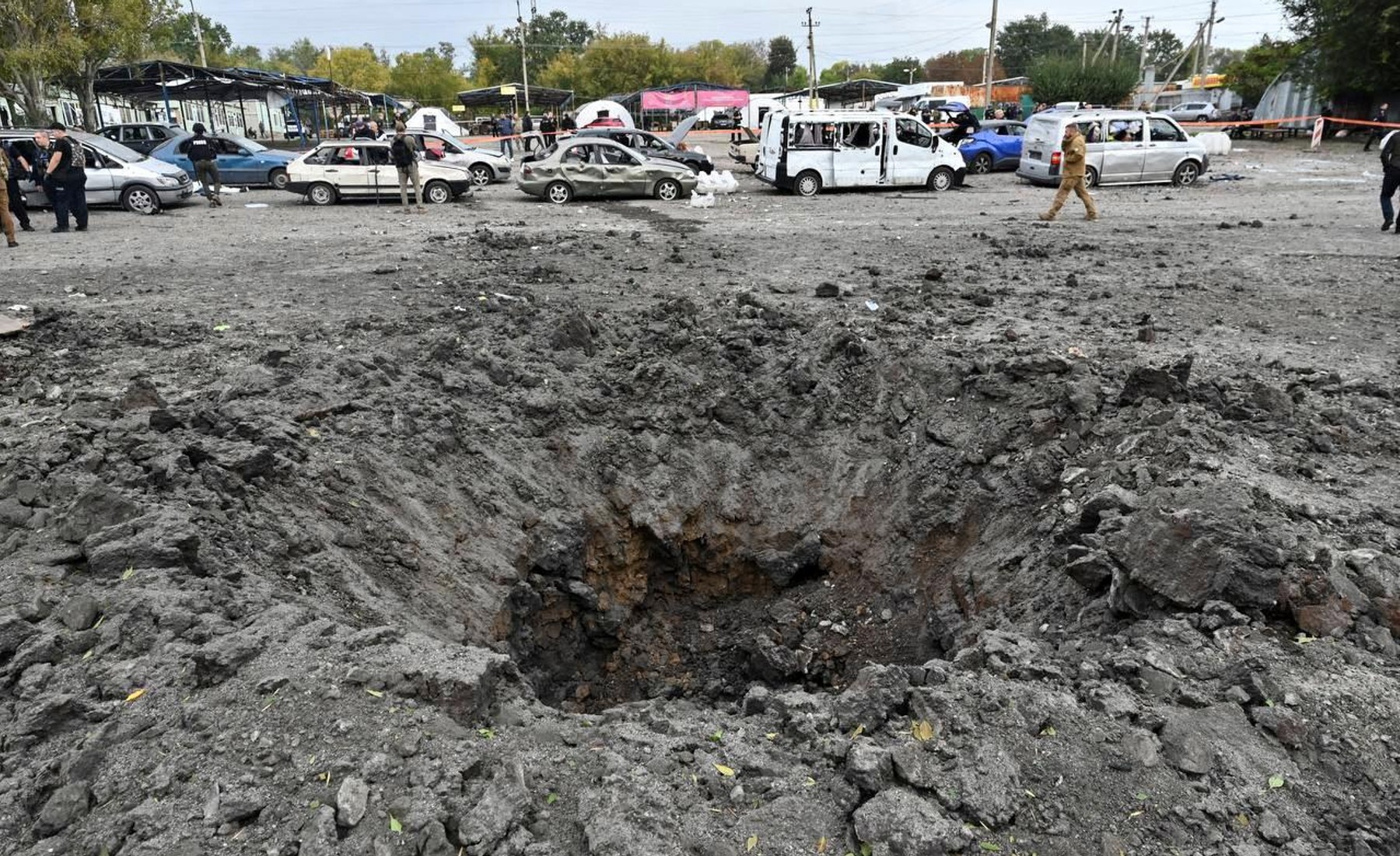
At least 31 people have been reported killed following a Russian airstrike on a humanitarian aid distribution centre and shelter in southeastern Ukraine, as emergency crews continue searching for dozens of people believed to be missing beneath the rubble.
Ukrainian authorities said the attack struck a school compound in Komyshuvakha, in the Zaporizhzhia region, on Monday, November 2.
The building was no longer being used for classroom teaching because of its proximity to the front line. Instead, it served as a shelter and a distribution point for humanitarian assistance to residents who remained in the area.
The reported death toll rose from 26 to 31 on Tuesday, November 3, according to updated information carried by Reuters and the Associated Press.
At least five people were reported injured, while more than 45 remained missing.
The figures have not been independently established through a complete forensic assessment, and authorities have warned that the number of victims could change as rescue work continues.
A humanitarian distribution site struck
Ukrainian President Volodymyr Zelenskyy said Russian aircraft initially dropped bombs on the school compound while residents were arriving to collect assistance.
According to his account, a subsequent attack struck the shelter where people had gathered.
Zelenskyy accused Russian forces of deliberately attacking civilians and said the location was known as a regular humanitarian distribution point.
That allegation has not been independently established as a legal finding.
Ukraine's emergency services reported that four police officers and two rescue workers were among those killed.
The deaths of emergency personnel have intensified concern about the dangers facing first responders during attacks on populated areas near the front line.
Officials said additional drones and continuing military activity complicated rescue efforts.
Emergency teams worked through damaged structures while searching for survivors and recovering bodies.
Dozens remain missing
The Associated Press reported on Tuesday that more than 45 people remained unaccounted for.
The number underscores the uncertainty surrounding the full scale of the disaster.
A person reported missing is not automatically confirmed dead, and casualty figures may be revised as families, hospitals and emergency agencies reconcile their records.
Authorities in the region declared three days of mourning.
The attack has become one of the deadliest reported incidents involving a humanitarian assistance site in the latest phase of the conflict.
Russia disputes Ukraine's account of the target
Russia's Defence Ministry said its forces had targeted Ukrainian military personnel in the area and claimed that up to 25 service members had been killed.
That is a Russian military claim, not an independently verified account of the people struck.
Ukraine maintains that the site was being used to provide humanitarian assistance and shelter to civilians.
The competing descriptions of the target remain significant because international humanitarian law requires parties to distinguish between civilian objects and military objectives.
Deliberate attacks against civilians are prohibited. Even when a legitimate military target is present, attacks must comply with rules governing proportionality and precautions to minimise civilian harm.
Determining whether a specific strike constitutes a war crime requires examination of the available evidence, the intended target and the circumstances known to those responsible.
No independent judicial determination concerning this particular attack has been established in the reporting reviewed.
Wider bombardment across Ukraine
The Komyshuvakha attack occurred alongside a broader wave of Russian strikes on Ukrainian cities and infrastructure.
According to the Associated Press, President Zelenskyy reported an overnight assault involving 289 drones, 17 ballistic missiles and 59 cruise missiles across multiple regions.
Those figures represent Ukraine's reported assessment of the attack, rather than an independently verified inventory.
Authorities reported dozens of injuries in Kharkiv and the Dnipro area.
Medical facilities and energy infrastructure were among the sites reported damaged.
The Ukrainian energy company DTEK said three power plants had suspended operations after sustaining significant damage.
Emergency electricity restrictions were introduced in affected areas.
Russia also reported extensive Ukrainian drone attacks against its territory, including damage associated with an oil refinery in Yaroslavl.
These claims illustrate the continuing exchange of long-range strikes even as international efforts to negotiate an end to the war remain active.
Peace negotiations face another test
The latest civilian casualties come ahead of planned talks involving the United States, Ukraine and Russia in Abu Dhabi on November 10 and 11.
The Kremlin confirmed the proposed meeting on Tuesday, following an announcement by US envoy Steve Witkoff.
The discussions are expected to address possible steps towards ending the conflict, including security arrangements and de-escalation.
However, the announcement of negotiations does not mean that a ceasefire has been agreed.
Military operations continue, and the parties remain divided over major political and territorial questions.
Zelenskyy argued that the attack on Komyshuvakha undermined hopes for humanitarian progress following a recent local ceasefire that enabled evacuations around Oleshky.
The relationship between battlefield developments and diplomatic negotiations remains uncertain.
Growing pressure on humanitarian operations
Humanitarian distribution points are essential for communities living close to active combat zones.
Residents who remain in these areas may depend on outside assistance for food, medicine and other basic supplies.
The destruction or closure of aid facilities can therefore have consequences beyond the immediate casualties.
It may disrupt regular deliveries, discourage people from gathering for assistance and increase the difficulty of reaching vulnerable households.
Emergency responders also face substantial risks when attacks occur near locations where civilians have gathered.
The latest incident reinforces concerns about protecting humanitarian workers and ensuring safe access to communities affected by the conflict.
International implications
The continuing attacks come as European governments and international organisations consider Ukraine's security, reconstruction requirements and humanitarian needs.
Further destruction of civilian infrastructure could increase the cost of recovery and deepen the challenges facing displaced communities.
The conflict also continues to affect global energy and commodity markets, although no specific new African or Nigerian economic consequence can be directly attributed to the Komyshuvakha attack from the available evidence.
What happens next
Rescue operations and casualty verification remain the immediate priorities.
Further updates from Ukrainian emergency services will be necessary to establish how many people are still missing and whether the reported death toll increases.
Independent investigation will also be important in determining the precise circumstances of the strike and assessing the competing accounts of the target.
The diplomatic focus will shift towards the planned Abu Dhabi negotiations, although there is no confirmed agreement to halt military operations before those meetings.
For now, the reported deaths of at least 31 people at a humanitarian assistance site represent a major escalation in the human cost of the conflict and a stark reminder of the risks facing civilians who remain near Ukraine's front lines.